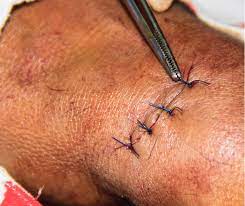
CUT WOUND STITCHING (suturing)

In Stock (1000000 items)
Ksh1,500.00 Ksh1,000.00

Suturing is the medical procedure of stitching a cut wound closed to promote healing, reduce infection risk, and minimize scarring Read more

Tags:
SKU: #oL5f80Huba
Suturing is the medical procedure of stitching a cut wound closed to promote healing, reduce infection risk, and minimize scarring. It should only be performed by a trained healthcare professional. For a deep or gaping cut, seek medical attention immediately. 
Do I Need Stitches? What You Need to Know - GoodRx
Signs that a cut needs stitches
You should get immediate medical attention for a cut that has any of the following characteristics: 
  • Is deep and gaping, or shows fatty tissue.
  • Has jagged edges.
  • Is located on the face or over a joint.
  • Was caused by an animal or human bite.
  • Is bleeding profusely and won't stop after 10–20 minutes of direct pressure.
  • Feels numb or causes numbness beyond the wound.
  • Is longer than a half-inch.
  • Contains a foreign object. 
The suturing process
A doctor follows a careful procedure to suture a wound: 
  1. Preparation: The wound is thoroughly cleaned to remove dirt and debris. A local anesthetic is administered to numb the area.
  2. Assessment: The doctor examines the wound to check for damage to underlying tissues like nerves or tendons and to determine if any internal layers need suturing.
  3. Suturing: Using a curved needle and surgical thread, the doctor sews the edges of the cut together. This can involve multiple layers of stitches, with deeper stitches bringing together underlying tissue and more superficial stitches closing the skin.
  4. Dressing: A dressing is applied to the wound to keep it clean and protected. 
Types of sutures
Doctors choose from different types of sutures depending on the wound and location: 
  • Absorbable sutures: Made of materials that the body can dissolve, these do not need to be removed. They are often used for deep layers of tissue or in children.
  • Non-absorbable sutures: These are made of a stronger material and must be removed by a doctor after the wound has healed. 
Alternatives to stitches
For smaller or more superficial cuts, a doctor may use other closure methods: 
  • Surgical staples: These are used for linear wounds on the scalp or extremities.
  • Adhesive tapes (Steri-Strips): These are used for smaller, low-tension wounds and are sometimes placed over stitches for extra support.
  • Skin glue: This is a quick and painless method for closing small wounds. 
Aftercare for stitches
Following your doctor's aftercare instructions is critical for proper healing: 
  • Keep it clean and dry: For the first 24 to 48 hours, keep the wound and dressing completely dry. After that, you can gently wash the area with mild soap and water.
  • Avoid soaking: Do not soak the wound in a bath or go swimming. Showers are preferable.
  • Restrict activity: Avoid any strenuous activity or movements that could cause the wound to reopen.
  • Follow-up: Your doctor will tell you when to return to have non-absorbable stitches removed. 
Specifications Descriptions

Latest Reviews

No Review
0

You May Also Like

Chat with Doctor

Get 50% Discount.

Lorem, ipsum dolor sit amet consectetur adipisicing elit. Exercitationem, facere nesciunt doloremque nobis debitis sint?